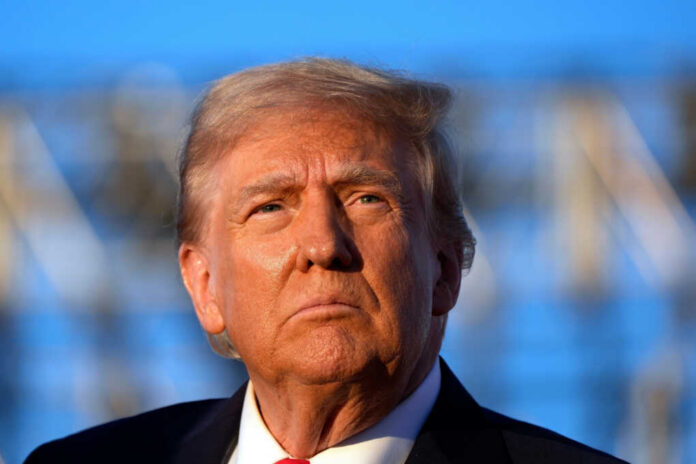
In a rare primetime address, President Trump put America’s election system on trial, even as official government reports say there is still no proof that a single 2020 vote was changed by a foreign power.
Story Snapshot
- President Trump declassified election security documents and claimed China stole data on about 220 million U.S. voters.
- Intelligence and Justice Department reports still say there is no evidence any foreign government changed votes or hacked voting machines in 2020.
- Trump used the speech to push stricter voting rules, deepening a long fight over election fraud versus voter access.
- Experts warn years of unproven fraud claims are steadily draining public trust in U.S. elections.
Trump’s Primetime Claims About China and Voter Data
President Donald Trump’s speech on election integrity centered on a dramatic claim: that China stole voter registration files on about 220 million Americans between 2020 and 2023. He said these files included names, addresses, phone numbers, and party ties, and called it “the largest compromise of election data in history.” The White House released newly declassified documents alongside the speech, saying they showed serious weaknesses in voter databases and other election systems. Trump argued this data theft proved a deep failure of the government to protect basic voting information.
Ahead of the address, aides told reporters the declassified records would focus on cyber threats, voter databases, and foreign influence operations, especially from China and other rivals. In the speech and supporting materials, Trump accused unnamed intelligence officials of hiding reports about Chinese activity and called for investigations, firings, and even criminal charges. He also said electronic voting and counting systems were “extremely exposed to attack,” pointing to past efforts in Venezuela as proof that machines can be misused to rig results. However, his own officials admitted before the speech that none of the newly released documents show any votes were changed.
What Official Intelligence and Security Reports Actually Say
The declassified 2021 Intelligence Community Assessment on the 2020 election, which covers Russia, China, Iran, and others, offers a very different bottom line from Trump’s speech. That report says there are “no indications that any foreign actor attempted to interfere in the 2020 US elections by altering any technical aspect of the voting process,” meaning no proof of hacked machines or changed vote totals. A joint unclassified summary from the Department of Justice and the Department of Homeland Security reaches the same conclusion, finding “no evidence that any foreign government-affiliated actor prevented voting, changed votes, or disrupted” counting or reporting. These documents admit hostile nations probed systems and ran influence campaigns but say they did not alter the actual vote.
The Justice Department and Department of Homeland Security also investigated claims that foreign governments owned or controlled U.S. election infrastructure and judged those allegations “not credible.” They note that Russian and Iranian cyber operations did compromise some networks tied to election functions, but they did not materially affect voter data, the ability to vote, or the tabulation and reporting of results. Ahead of Trump’s 2026 address, House Intelligence Committee Democrats warned the administration against “weaponizing declassified intelligence,” stressing that no new reports had been given to Congress showing vote changes by foreign actors. Their message was simple: the public intelligence record still does not support the leap from cyber probing and data theft to stolen elections.
A Long Fight Over Fraud Claims, Voting Rules, and Public Trust
Trump used the primetime moment not only to revisit his 2020 loss but also to push for a stalled bill with strict voter identification rules and tighter limits on mail ballots, framed as the “Save America Act.” This fits a pattern that experts have tracked since at least 2016: political leaders make broad claims of fraud and foreign interference, even without strong proof, and then use those fears to argue for more restrictive voting laws. Studies show that repeated exposure to unsubstantiated fraud stories lowers people’s confidence in election fairness, even when they still support democracy itself. Over time, this erodes trust across the board, whether someone leans conservative or liberal.
On July 16, 2026 (yesterday), President Trump delivered a primetime address from the White House on election security. In it, he:
• Publicly referenced intelligence claiming China illicitly acquired ~220 million U.S. voter files (names, addresses, phone numbers, political party…— American Girl (@BlueLadyDi) July 17, 2026
For many Americans, Trump’s speech tapped into a deeper frustration that crosses party lines: the sense that powerful insiders, sometimes called the “deep state,” are not honest about threats and are more focused on keeping control than fixing real problems. Conservatives hear the message as proof that global rivals and domestic elites have gamed the system; liberals fear that fraud claims are being used to lock some citizens out of the voting booth. Research on misinformation and election denial movements shows that when leaders regularly repeat doubtful claims, belief in fraud spreads even when official audits and court cases find no major wrongdoing. The result is a growing gap between what government data shows and what many voters believe.
Why This Matters for Election Security and Self-Government
Security experts agree that no computer system used for voting can ever be perfectly safe from hacking, which is why they urge strong post-election audits and paper backups. The National Academies report on election integrity recommends routine, public audits of both processes and results so citizens can see checks happening after every vote. This technical reality gives some weight to Trump’s focus on machine vulnerabilities and foreign cyber threats, even if the evidence so far does not show actual vote changes. The core challenge is how to talk honestly about real risks without overstating them or turning them into permanent claims that the system is rigged.
Across the political spectrum, many people now feel the federal government is failing to protect both the security and the fairness of elections and that elites in Washington use intelligence, investigations, and even declassification choices to serve their own power games. Trump’s address reinforces that distrust for his supporters and deepens suspicion among his critics about how intelligence is being used. At the same time, the ongoing dispute between dramatic claims and cautious official reports makes it harder for ordinary citizens to know whom to trust. In a country built on the idea that leaders gain power through free and fair elections, that growing doubt about the system itself may be the most serious threat of all.
Sources:
reuters.com, npr.org, stylemagazine.com, trumpwhitehouse.archives.gov, fakti.bg, youtube.com, dni.gov, intel.gov, int.nyt.com, gottheimer.house.gov, 2021-2025.state.gov, pmc.ncbi.nlm.nih.gov, misinforeview.hks.harvard.edu, cambridge.org, eipartnership.net, brennancenter.org